Goal Setting That Actually Works: The Missing Piece Most People Skip
Goal Setting That Actually Works: The Missing Piece Most People Skip
Are you tired of setting New Year’s resolutions just to fall off the rails by February? Same. Most people don’t fail because they’re lazy. They fail because they’re missing one critical piece that turns a goal into reality.
That missing piece?
An action plan.
A goal without an action plan is just a wish wearing a fancy outfit.
Let’s fix that.
The Missing Piece: Your “Battle Plan”

I like to call action plans Battle Plans - because you’re not “hoping” your way into progress. You’re taking territory.
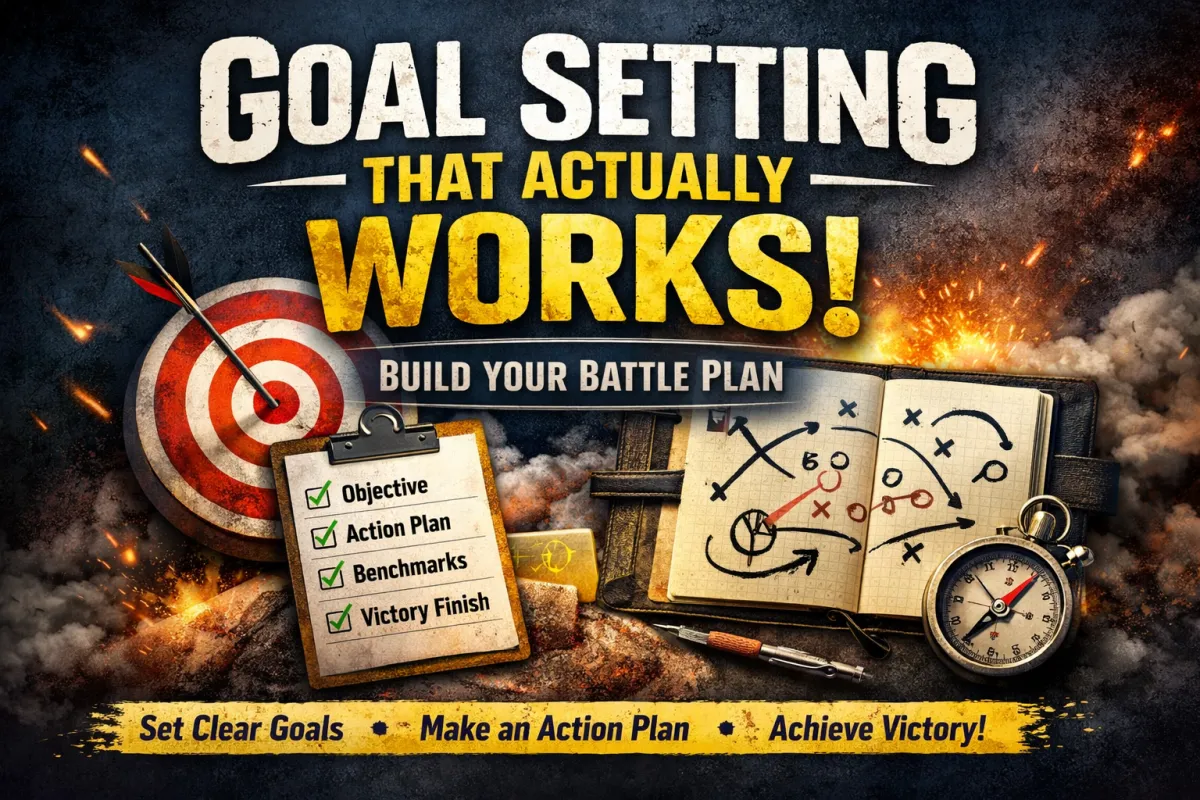
A Battle Plan has three parts:
Objective (What you want)
Action Plan (How you’ll get it)
Victory Finish (How you’ll know you won - and how you’ll keep the win)
Let’s break it down.
1) Objective: What Do You Want to Accomplish?
This sounds obvious… which is exactly why people skip it and then act shocked when the goal falls apart.
Your objective needs a clear finish line, because vague goals don’t create clear actions.
Build a strong objective:
Be specific – Make it measurable. If you can’t measure it, you’ll drift.
Be realistic – If it’s not achievable, your brain will sabotage it with “reasons.”
Set a timeframe – No timeframe = procrastination with extra steps.
Examples (Bad vs Better)
Bad: “I want to lose a ton of weight this year.”
What is “a ton”? When are you done? How will you know you’re winning?
Better: “I will lose 15 pounds by April 30 by exercising 3x per week and tracking calories 5 days per week.”
Bad: “I’m going to read 50 books a day for the whole year.”
That’s not a goal. That’s a cry for help.
Better: “I will read 12 books this year by reading 20 minutes a day, 5 days a week.”
2) Action Plan: How Will You Achieve the Goal?
This is where most goals die. People set an objective, feel motivated for 48 hours, and then rely on willpower.
Willpower is great… until you’re tired, stressed, annoyed, or you see a donut.
Your action plan is the part that keeps you moving when motivation disappears.
Build a strong action plan:
Be specific – What exactly will you do, and when?
Be realistic – Your plan should fit real life, not fantasy life.
Set benchmarks – Smaller targets keep you motivated and help you course-correct.
Quick benchmark examples:

If your goal is to lose 15 pounds by April 30:
Benchmark 1: Lose 4 pounds by Feb 15
Benchmark 2: Lose 8 pounds by March 15
Benchmark 3: Lose 12 pounds by April 15
Victory: 15 pounds by April 30
Benchmarks do three things:
Give you momentum
Give you mini-wins
Show you early if your plan needs adjusting
3) Victory Finish: How Will You Know You’ve Won?
This part matters more than people think.
If you don’t define the finish line, your goal will feel endless - and endless goals get abandoned.
Define the victory:
Have a measurable endpoint – Know what “done” looks like.
Create an exit plan (if needed) – Some goals are temporary sprints, not permanent lifestyles.
Example: If your goal is “cut sugar,” what happens after you hit the goal?
Do you add it back slowly?
Do you set a maintenance rule (like weekends only)?
Do you replace it with something healthier?
A lot of people hit the goal… then immediately lose the win because they never planned for “after.”
One Last Tip That Increases Your Odds (A Lot)
Write it down. Not just in your head. Not “I’ll remember.” Write it down.
When you write your goal and plan, you stop treating it like a mood and start treating it like a decision.
The Real Takeaway
Life is a mental game. Goals aren’t won by hype. They’re won by strategy.
So don’t just set goals this year - build Battle Plans:
Objective
Action Plan
Victory Finish
Now go take territory.
And as always: stay calm, stay clear-headed, and play the game on purpose.
